


Epidemiologia e prevenzione delle malattie cerebro e cardiovascolari

Epidemiologia e prevenzione delle malattie cerebro e cardiovascolari
The population-based National Register of major fatal and non-fatal coronary and cerebrovascular events is a surveillance system on the Italian resident population aged 35-74 years.
It was implemented in a 2-year period (1998-99) with the aim of evaluating the feasibility of a registry, based on the resident population, to estimate the frequency of coronary and cerebrovascular diseases in representative and geographically strategic areas of the Country.
The National Register collects data with the supervision of the National Health Institute.
The Register allows to estimate, for men and women aged 35-74 from the North the Centre and the South of Italy:
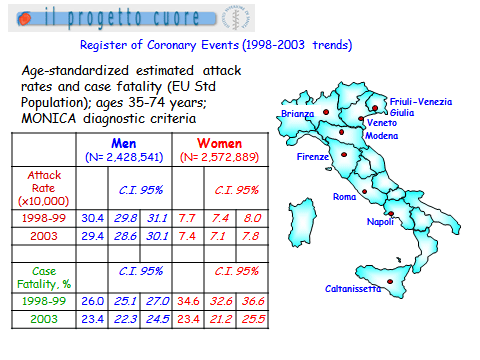
During the first period, in 1998-1999, the Register was implemented with data from 8 areas in the country: the Brianza area, the municipalities of Caltanissetta, Florence, Modena, Naples, Rome (ASL Roma-C), the regions Friuli-Venezia Giulia and Veneto. The involved resident population numbered about 5 billion.
In 2003 the Register was reactivated in regions Friuli-Venezia Giulia Veneto, and in the municipalities of Florence and Naples with the objective of estimating the trend of attack rates and case-fatality rate by applying the positive predictive values (PPVs) estimated in 1998-1999.

Read more
© Istituto Superiore di Sanita (ISS)